
The Personal Daimon Personified
‘He had more trust in his familiar than in God, that there was more profit in it than in God, and that he gained nothing by looking to God, whereas his familiar always brought him something.’
- Court record of Gentien le Clerc, sentenced to death, 1615
The Familiar, or Personal Daimon, is both real and unreal, material and not, neither of our world nor outside of it. They are glimpsed most readily at dawn or dusk, yet are not bound to the constraints of time. They are beings of liminality who are formed from the void we call the imaginal. Ungraspable and intangible to us in every way, the only certitude of daimons is their existence.
Every culture has its own version of these elusive beings, with the best-known to us in the West being the faeries. Every aspect of the fae is notoriously impossible to classify. Do they originate from the sky, or are they born of the earth? Some are as tall as trees, and others are as small as bees. The faeries of lore are largely wingless, though many persons report them as having wings like those of insects. They have been seen wearing green caps, red caps, or no caps at all. Some are described as radiant and beautiful beyond description, while others are too frightening to behold. In all of their variations, it would be unwise for us to assume what, or who, faeries are, beyond being daimonic.
In pre-Islamic Arabian cultures, there were the jinn. Similar in concept to the fae, jinn have carried over into early Islam. The jinn are described in the Qur’an as beings created by Allah, but not of black mud, like humans, but of smokeless fire. The jinn are spiritual equals to humans and contain free will. As such, they are capable of doing both good and evil. The jinn have their own society, separate from the human realm, and it is generally inadvisable to seek them out.
More well-documented examples of daimons come from the Greeks, who have their fauns, dryads, nymphs, and naiads. The Romans understood daimons as being land spirits, genii loci, who inhabit every aspect of nature. The equivalent of the Personal Daimon was called the Genius. The Genius/Personal Daimon/Familiar has existed throughout recorded human history, and continues to do so today.
What differentiates the daimon from the Personal Daimon is its curious interest and attachment to us humans. Again, most cultures have their explanations of what daimons are and also how and why they become involved with us. Are they assigned to us at or before birth, as Christians believe of the Guardian Angel, or are they otherwise met with and subsequently obtained? This is where the mystery lies. The answer is forever unknowable, much like the origin of daimons themselves. What is knowable is that daimons are discoverable.
The analytical psychologist and mystic, Carl Jung, famously encountered his Personal Daimon, Philemon, in a dream in 1913. Philemon took the form of an old man with kingfisher wings and the horns of a bull, carrying with him a ring of keys. In his memoirs, Jung wrote of having long conversations with Philemon while strolling the garden of his home in Küsnacht, Switzerland. Philemon was a guide and mentor to Jung, even going so far as to teach him about psychological objectivity and the actuality of the soul.
For the witch, the Personal Daimon, or what we call the Familiar, lies in wait in the recesses of non-ordinary reality. Familiars come to us as lovers, guides, and confidants. Soul-Mates. They appear in times of great desperation or when adequately summoned; an occurrence often the same. Periods of extreme sickness, hunger, fatigue, or an otherwise precarious state teetering between life and death swiftly invite the Familiar in. It is the defiantly courageous witch who, having long-suffered, appeals most to the Familiar. It must be stressed that these conditions are not a prerequisite, although they are conducive to easy entry into the Otherworld. For those who have not balanced on the knife’s edge of mortality, entry is granted in another way.
The Familiar is neither a construction of the imagination nor a nifty psychological tool of the mind. For the witch, the Familiar is an ally in every sense: friend, lover, partner, and equal. Should we cultivate this relationship and heed their advice, they will guide us to reach our full potential. Not everyone has the same kind of potential, nor should they. Some people obtain fame and riches, going on to become household names, while the majority pass into anonymity. One potential is not more or less full than the other, despite what society teaches us. For some and their Familiars, living a simple yet mindful life by tending a garden or caring for the elderly is what it means to live fully. If you are unsure of your potential, your Familiar can help guide you to it.
The Familiar is not bound by corporeality and, as such, is capable of numinous forms at any given time. In one moment, they may appear as a perplexing cluster of lights, and in another, as a pillar of fire. To the witch, they most readily appear in the guise of an animal or an animal-human hybrid. One may wholly desire for their Familiar to take on the form of an impressive predator or majestic beast, only to be met with one who presents as a lowly fly or slimy snail. Know this, despite their chosen outward appearances, each Familiar has its own discernible personality and strengths. Most importantly, each Familiar works seamlessly in tandem with the needs of the witch and the situations they find themselves in. Desire not, the Familiar always has the witch's best interests in mind, for ours align with theirs.
Early amateur anthropologist and author, Margaret A. Murray, wrote in 'The God of the Witches' that witches of old had two main familiars, the ‘Divining Familiar’ and the ‘Domestic Familiar.’ The latter was said to belong solely to the witch and “was kept in her house, and was often called an Imp or Spirit, and occasionally a Devil, was fed in a special manner and was used only to carry out the commands of the witch.” The Divining Familiar belonged not to the individual Witch, but to the coven as a whole. It was lent by the Master (the Devil) of the coven and used solely for divination purposes. Although we cannot take what Murray wrote as full truths, we can look at traditions that have resurfaced today. Though a Witch may indeed have multiple Familiars, the separation of them does not often happen in the way described by Murray. Today, a coven would more likely have a ritualistically created egrigore than a 'Divining Familiar' lent by the devil.
Despite much documentation on the use and keeping of a Familiar, it is unclear whether these familiars were of flesh and bone. I believe that, by and large, they were non-corporeal. Most testimonies, albeit recorded by their antagonists, describe Familiars as taking the form of an animal or human, implying that they are not flesh and bone. Perhaps some Witches did believe household creatures (i.e., mice, toads, cats, etc.) were able to carry out their magical biddings; however, evidence is weighed in favor of a more daimonic link between Familiar and Witch. We must also remember that many allegations of keeping live Familiars were confessed to during torture.
Because Familiars are non-corporeal, you may eventually seek to offer your Familiar a "body" by ritually inviting it to inhabit a vessel or spirit house. This process must be consensual and mutually beneficial, as not all Familiars want or need a physical dwelling. If you find that your Familiar enjoys habituation, take care to attend to their needs regularly. Needs of a Familiar vary according to their form and function, but nearly all enjoy being offered incense, light, and water. In time, you will learn which offerings they prefer. Examples of vessels include a lovingly made ceramic pot, a repurposed tea kettle, an ethically sourced and preserved animal corpse, or any other home object that feels appropriate. A Tutelary Spirit of mine has chosen a resin skull that I feed with offerings of herbs, sigils, and jewelry.
A surprisingly good interpretation of a Familiar can be seen on Netflix’s show, “Chilling Adventures of Sabrina.” In the very first episode, Sabrina Spellman summons a Familiar, who takes the form of a cat named Salem. She does this by entering the woods with a walking stick and a bell, and calls out,
“Spirits of the forest, I pronounce my intentions to thee, come forth and seek me, an equal we will be. Not master and servant, but familiar to familiar. To share our knowledge, our spirit, and our traits.”
Frankly, this is a phenomenal line from a television show that I would recommend replicating as a spell!
Finding Your Familiar
Meeting with our Familiar is of the utmost importance before delving into the oftentimes murky waters of witchcraft. A Familiar not only helps protect us from psychic and spiritual harm, but also provides insight into the many scenarios in which we will find ourselves. They are like trail guides who want to help us reach our destination, and who never intentionally put us in harm's way.
The following meditation is to be attempted at home and in solitude. All you need is a quiet hour or so, completely disconnected from your phone and media. I recommend doing this at dawn or dusk, as these are the liminal times.
Getting a Glimpse: Sit comfortably and stare at a point on the wall. You may place a target object if you’d like, such as a small strip of tape or paper. Your eyes should be rested, as if you are daydreaming, and not focused on anything else. If your eyes get heavy, let them close. When you come to, whether by an alarm or sudden waking, record any of your findings or visions. If you have fallen asleep, try again when you are more rested and have the energy to keep awake.
…Crow has arrived in my mind’s eye. A purple and gold aura emits from its head, and it hovered still, frozen in space and time…
Another way to meet with a Familiar is to seek assistance from someone who can help navigate. With this method, you will be entering a trance into your ‘Inner Landscape,’ a term used by author and Wiccan elder, Ivo Domingeuz Jr. For convenience, I have laid out every step so that you can refer to it at a later time.
Note: Ventures into the Otherworld, as well as the general practice of witchcraft and the occult, are not without their risks. This is the reason why we begin with the importance of meeting and connecting with our Familiar. Without their guidance and protection, serious psychic stress or injury can happen. The study and practice of the occult does not provide us with a one-way mirror! Magical Practitioner Draja Mickaharic says it best with,
“As we enter into the study of magic and the occult, we lose the protection that our ignorance provides.”
Therefore, before proceeding, we should take a moment to talk about personal protection. Assuming that many of you have a background or strong interest in witchcraft, you may already have on you an amulet, pouch, or other charmed object. This is a great start to establishing personal protections, but it is not always enough. Something that is often overlooked is that we need to be specific about what we need protection from. For example, I wear a silver ring that I have charmed to protect against the Evil Eye, but it may not be so great at guarding against dog attacks or lightning.
A simple form of protection is the ‘Circle-Cross Method.' I originally came upon this method in the book “Treading the Mill,” by Nigel G. Pearson. While his method is great, I have amended it for the absolute beginner. With it, we will establish an internal compass, positioning ourselves and our work in the world, ordinary and not.
Circle-Cross Method (amended): Stand facing North and place your feet about a foot apart, and place your arms by your side. Close your eyes and take a few full breaths.
Take your dominant hand and touch your brow. Say;
“From Above”
Trace a line from your brow to your navel and say;
“To Below”
Raise and outstretch your left arm, say;
“From my left”
Do the same with your right, say;
“And to my right”
Cross your arms over your chest, say;
“I am whole and contained.”
With this method, we are creating an orb or bubble of protection against unseen forces while in trance. You may also choose to do this before any spellwork. There are many variations of this, and if you’d like to learn more, I encourage you to research the term ‘Laying / Hallowing the Compass.’
The prolific Christian Mystic, Dion Fortune, offers a different method in her book, “Psychic Self-Defense.” She writes, “[Facing east] Touching his forehead he says “To Thee, O God (touching his solar plexus) be thy Kingdom (touching his right shoulder) and the Power (touching his left shoulder) and the Glory (clasping his hands) unto the ages of the ages. Amen.”
Before entering the daimonic realm, the Otherworld, we will go over each step laid out before us. This is to provide you with a template of intent.
I’d like to discuss the method of drumming to induce trance. While this method of auditory stimulation has been done for a millennium by people the world over, it is retained in modern-day by Indigenous and First Nations communities. It is not my intent to replicate or falsely portray any Indigenous practices. Drumming is an auditory stimulation, and it works for me and many others. Additional methods include visual stimulation, repetitive movement, gazing, inducing physical stimuli, ingestion of psychedelics, breathwork, etc. The inclusion of transformational drumming draws inspiration from multiple wisdom traditions, but is offered today as a modern practice.
TEMPLATE OF INTENT
1) Set your intention of meeting with your Familiar and cleanse yourself with the fumigation of herbs. I recommend using cedar because of its fiery, cleansing, and protective qualities. It is also used to designate spaces as sacred. Mugwort is also a good choice and will aid in easing the mind.
2) Next, break up the still air with sound. This is another form of cleansing, and it also helps shift our minds into a ritualistic setting. Designating a space for ritual is just as important as the ritual itself.
3) We then read aloud the following incantation, offered by the authors of “Besom, Stang, & Sword,” Christopher Orapello & Tara-Love Maguire.
“Familiar spirit of my soul,
Please make your presence known.
Familiar spirit of my head
From birth, through life, till I am dead.
Familiar spirit of my flesh,
Show yourself at my request.”
ENTERING TRANCE
4) Lie down and listen to the sound of drumming. Drumming works as a means of accessing trance because it affects our brain waves. Slowing down brain activity allows inspiration and untapped wisdom to flood in. The lull of the drum feels like being pulled out to sea and onto other shores. It is your raft and windsail. Eventually, you might acquire a drum of your own and come to think of it more as an ally than as an object. When I can’t drum for myself, I use an iPhone app called 'Drum Journey' by William Langton of Mindful Bear Apps.
5) Picture in your mind's eye an actual place from your memory that was private and special to you. For example, I think back to a tree that stands in a field in my hometown. I would sometimes sit by this tree on my walks after school. Some people imagine bedrooms, attics, pools, or lakes. As long as you can summon it clearly in your mind, it will work for you. In this place, imagine that you can descend into the ground, down a flight of stairs, or in an elevator. Descend in the direction of a left-turning corkscrew spiral.
…I am walking in a field and approaching the tree. I can hear the chirping of crickets and feel the gentle heat of the afternoon sun on my shoulders. I place my hand on the bark of the tree, and a creaking moan emits from its core. The ground has swallowed me up. I cling to the roots of the tree until I realize that I am not in danger. Acceptance is necessary, and so I slip further into the open Earth…
6) As you feel yourself lowering into the ground, you will start to sense a new space. Allow your vision to adjust to the surroundings. For me, it is a dirt tunnel. Others have told me that they see a room with a door on the other end of it. Either way, you will begin walking down the tunnel or towards the door very slowly. We use this time to further entrench ourselves and distance our minds from the surface of our physical body. It is at this point that another shift happens, and with it comes another barrier. For me, it appears as an old stone archway that I must draw upon with a symbol for it to open.
…The tunnel is dark. I place my hands on either side to navigate my way. I can feel the cold of the dirt and smell the earth. I’m pulled deeper into the bowels…
7) Upon passing the barrier, again allow your vision to adjust. A lot of time in the Otherworld is spent doing just that, taking in new surroundings and trying to make sense of them. Your first time entering might be very dark, and you may be without peripheral vision. Over time, this will come to be your Sacred Center, Grove, Otherworld Garth, or, as I’ve begun calling it, your Launching Pad. You might hear the fluttering of wings, buzzing of insects, primal howls, heavy footsteps, or any array of sounds. Focus and bring these beings in front of you, one by one, and ask, “Are you my Familiar?” Eventually, one will stop and connect with you telepathically or verbally. Be sure to ask its name. If it does not offer it right away, be patient. It may require many visits before it does.
…It is here that Crow tethers itself to me. Its reveal during meditation was not just a vision of kinship, but an invitation to the Otherworld. It flies upon my shoulder and presses its head against mine and says, “Finally, you’re here, let’s fly!”…
8) Once you have connected with your Familiar Spirit and made conversation, thank them and turn back around and leave. Ascend in a right-turning corkscrew spiral. The drumming will assist with this as its rhythm will change and encourage you to end your session. When you return to your physical body, be sure to immediately write down everything you did, saw, heard, and felt. Afterwards, drink some water and eat a small snack.
My Human Design
The following “Human Design” chart analysis is from Nadia Quinn’s website, www.howtobeyourselfhd.com
Projector
"You are an energy guide who sees how people and systems work. Your gift is recognizing what others may not see and offering insight that helps direct energy in the right way. You are not here to generate constant energy, but to observe, understand, and guide. When you allow yourself to be recognized and invited, your wisdom naturally attracts the right people and opportunities."
Strategy (how you operate best): Wait for the Invitation
"Your energy works best when you are seen/recognized and invited to share your insight. You are designed to see how people and systems work, but that guidance lands most powerfully when others are ready to receive it. Instead of pushing, initiating, or overexerting yourself, allow the right people and opportunities to see you first and recognize your gifts. When you are seen and invited, your guidance naturally has the greatest impact."
Authority (how you make decisions): Splenic
"Your decisions come from your intuition — a quiet, instinctive knowing in the body. This awareness often appears instantly, like a subtle signal that something feels right or something feels off. It usually comes only once and very quickly, before the mind has time to analyze it. The key is learning to trust that first intuitive ping instead of overthinking it."
Definition (how your energy connects): Split Definition
"Your defined centers form two separate circuits in your chart. This can feel like two internal voices processing information at the same time, and interactions with others can help bring those voices into alignment."
Profile (archetype): 6 / 2
"You have natural talents that often grow strongest when you give yourself time alone to reflect and recharge. As your life unfolds in phases, the experiences you gather gradually deepen into wisdom and perspective. Over time, your quiet insight becomes something others naturally look to for guidance."
Incarnation Cross (life's work/purpose): Left Angle Cross of Distraction (56/60 | 27/28)
"You came into this world to distract others and take them away from what they are doing or thinking, to bring them directly into your own stimulation, experience, or story by interrupting them or drawing their attention to you, whether positive or negative, because distractions don't always end well for you."
Signature (green light / all good): Success
"When you feel success, you know you're on the right track."
Not-Self Theme (red light/check engine): Bitterness
"When you feel bitter, you’re not operating in alignment with how you’re designed. Check in with your open centers and clear out what isn’t yours, make sure you’re making decisions based on your authority, and tune into your defined centers."
Digestion (how you best take in food & info): Low Sound
"You digest food and information best in quiet—little to no background noise, minimal conversation, a calm auditory space. Silence or low sound helps your system process most efficiently."
Awareness (How your mind processes): Acceptance
"Your mind accepts experiences, people, and situations as they are, without trying to change them—fully respecting their nature and accepting that there are some things it can do nothing about. If you find yourself at peace with what is rather than fighting it, that's your mind working exactly as it's meant to."
Sense (sharpest physical perception): Feeling
"You experience the world through feeling—picking up on the frequencies, vibrations, and emotional energy around you. How something feels tells you whether it’s right for you or not."
Motivation (what drives your thinking): Need
"When you are aligned, you are driven by Need—you zoom out, see the big picture, and then know the next few things that actually need to happen. You’re here to cut through the noise and focus on what truly matters."
Perspective (how you see the world): Wanting
"When you are in the right environment for you, you see the world as you are meant to. And in your case, you are meant to see everything related to what people lack and want—the need that really exists, the opportunities for exchange, what's useful and what isn't. If you notice the gap others miss, that's your gift."
Environment (ideal place to be): Mountains
"You thrive in environments where you are elevated—physically or energetically—so you can see the bigger picture. Being a bit above it all, with space and perspective, helps your system feel clear and in control of who you engage with."
Open Centers (designed to be open!): Sacral, Solar Plexus, Heart, G, Throat
Sacral
"Do you know when enough is enough? The Sacral Center is the center of life force energy and sustainable work energy. When your Sacral is open, you don’t have a constant internal battery generating energy in your body. Instead, you are very sensitive to the energy of the people around you. You can amplify the life force of others, which may sometimes feel energizing — and other times leave you feeling completely drained. Learning to recognize when your body has had enough, and giving yourself permission to rest, helps you stay balanced and avoid burnout."
Solar Plexus
"Are you overwhelmed by other people’s emotions? The Solar Plexus is the center of emotions and feelings. When your Solar Plexus is open, you are highly sensitive to the emotional energy around you and can easily pick up on the moods and feelings of others. Because of this openness, it can sometimes be hard to tell which emotions are yours and which belong to someone else. Your gift is deep empathy and emotional awareness — learning to stay centered and allow emotions to move through you helps this sensitivity become one of your greatest strengths."
Heart
"Are you trying to prove your worth? The Heart Center (also called the Ego Center) is the center of willpower, desire, and self-worth. When your Heart is open, your sense of willpower and value can be influenced by the people and expectations around you. You may sometimes feel pressure to prove yourself, overcommit, or push beyond your limits in order to gain recognition or approval. Remembering that your worth isn’t something you have to prove allows this openness to become a source of honesty and authenticity."
G
"Are you trying to figure out who you are or where you're going? The Identity (also called the G) is the center of love, direction, and sense of self. When this center is open, your identity and sense of direction are influenced by the people and environment around you. This can create uncertainty about who you are or where you're headed, but your gift is the ability to shape-shift and experience many different expressions of yourself. When you stay open instead of trying to lock into one fixed identity, it becomes one of the most powerful parts of your design."
Throat
"Do you feel the urge to be heard? The Throat is the center of communication and expression. When this center is open, your voice is activated by your audience and the environment around you. This can create pressure to speak in order to be noticed, or to hold back out of fear of being misunderstood. Your gift is a flexible and perceptive voice — when the right moment and the right people appear, your words arrive at exactly the right time."
Defined Centers (built in consistent energy): Root, Splenic, Ajna, Head
Root
"You are a rock in the surf. The Root Center is the center of pressure, adrenaline, and the drive to get things done. When your Root is defined, you have a steady source of motivational energy that helps you stay grounded even when life gets intense. You often work well under pressure and can keep a cool head when things feel chaotic around you. Your Root provides the fuel to move into action — just remember that balance between tension and relaxation is where this energy works best."
Splenic
"Your intuition is a reliable guide. The Spleen is the center of instinct, intuition, and survival awareness. When your Spleen is defined, you have a steady and reliable sense of what feels healthy, safe, or correct for you in the present moment. Your instincts often show up as subtle, immediate signals in the body — a quiet knowing that something feels right or off. Learning to trust those intuitive nudges allows this natural guidance system to support your well-being and help you move through life with confidence."
Ajna
"Your mind processes the world in a consistent way. The Ajna is the part of the mind that processes information and forms beliefs and opinions. When this center is defined, you have a steady way of thinking and making sense of ideas. Your perspective tends to remain consistent even when the opinions around you change. This mental clarity allows you to understand complex concepts and express them in a clear and structured way."
Head
"You are a source of inspiration. You possess the constant and reliable ability to generate inspiring thoughts and ideas. Your mind is under pressure to be constantly active, and your head rarely finds rest. It is important for you to find ways to channel and express this energy meaningfully, whether through creative writing, philosophical discussions, or other forms of expression. Avoid passing on unnecessary doubts or ruminations. Recognize that you have the natural gift to inspire others with your questions and ideas."
Psilocybin Therapy, First Session
First Session took place on January 19th, 2026
The following account was recorded the day after a six-hour psilocybin therapy session.
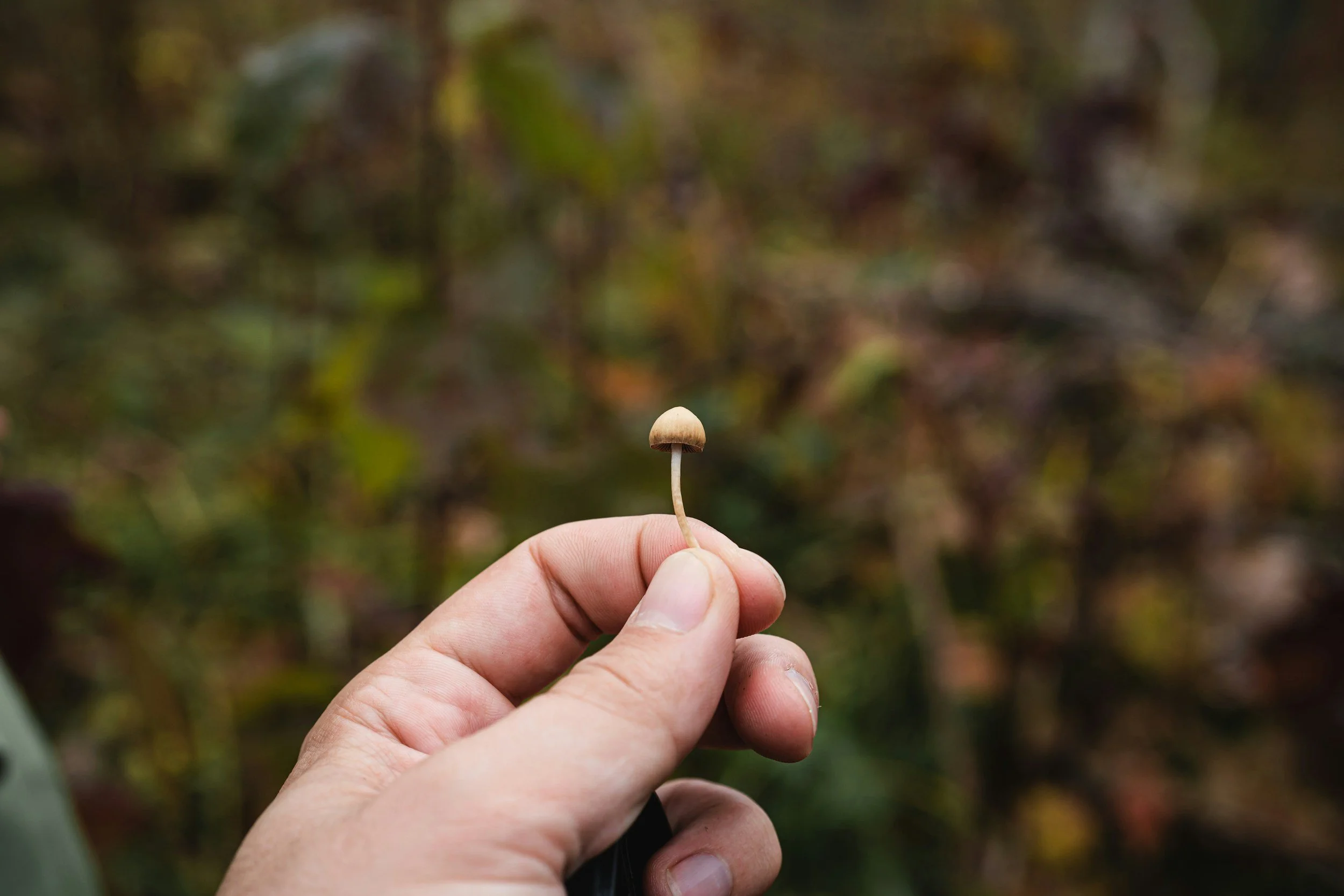
“My therapist, [redacted], arrived at my house around 10:30 am. We spoke about the effects of psilocybin and what I should expect to feel, as I’ve never used it before. I set up a comfortable space on the floor of my studio. We did a general grounding exercise, and I invited my “spirit team” to join us in the space. I then drummed for a short time to get into a proper headspace. [Therapist] then instructed me to eat the mushrooms. To me, they smelled slightly cheesy, but tasted almost like dried porcini mushrooms. They did not taste good, though not entirely unpleasant either. It wasn’t long before I began to feel the effects. The sensation was creeping, as though English ivy had spread to every end of my body. I could visualize the spreading as frost on a window. I did become very cold and needed a space heater and an additional blanket. The cold, though constant, began to feel pleasant, like stepping into the cold for a fresh breath of air. As the creeping sensation spread, I sensed it in my many scars. I felt that the “ivy” could not pass through the scars at first. The scars were a foreign body that the “ivy” could not grow over. A small fear arose. I reassured the “ivy” that the scars were, in fact, a part of me, natural or not. The fear subsided.
A short time passed, and I began to feel very feminine. I could visualize myself as a young woman in 1700’s France. I wore a ruffled celadon green dress with matching ribbons in my hair, which was long and brunette. It was at this point that I said, aloud, that my lips were going numb. My therapist asked if I related that feeling to anything, and I responded, “opium.” My therapist asked if I had done opium, and I replied, “Not in this lifetime.” I have always felt as though I had died from opium, and this sensation was familiar. I then held a strawberry aloft and ate it delicately. I was then back in 1700’s France, lounging on a blanket by the river. I was alone at first, save for my valet in the near distance. I then felt the presence of a younger sister with me, though I could not see her face. I said aloud how good it feels to gossip and be out of view from others. It felt delicious. I then felt as though I would be found out or caught in some way. Being too happy could be met with admonishment. It was around this time that Cleo (my cat) entered the room. She scanned the perimeter before settling in my arms. She stayed with me the entire session.
In the trip, I was then brought to the Alps. I was an eight-year-old blonde boy and was lying down again. This time, I was in front of a small hearth fire. My cat, Cleo, then became a very large dog in this scene. The dog was wolf-like, and we lay together in front of the fire. The feeling was that we had just come indoors after a long day outside. I felt imaginative, as if my entire day had been spent playing make-believe in the forest. It was one of the best feelings in the world. I did not see my parents, but knew them to be nearby. I was unafraid. The mountains themselves became “Mother.” The name, “Frau Holda,” came to my mind as I viewed the mountains as “mothers.” I did not encounter her visage, although I could feel her embrace. She was stern yet loving. On one hand, she was as harsh as a winter’s wind, and on the other as warm as fresh-baked bread. She felt respectfully distant and not overbearing.
As my thoughts turned to my own mother, my thoughts were directed to a pond. This pond looked very much like the one at my grandmother’s house. My mother’s energy was that of a fish in this pond, and also of a clear quartz. My energy was like that of a toad or a frog, and also a deep garnet. My grandmother was a turtle in this pond, and her stone was an emerald. The three of us experienced the pond in very different ways. My mother, the fish, felt separated from me (as a frog), and even more so from her mother, the turtle. Although I felt distant as a frog, I knew that my mother had the company of other fish. As a frog, I could spend much of my time underwater, with the fish, but also on land with the turtle. I was a familiar guest to the fish, but was at home along the banks of the pond. My grandmother, the turtle, lived like the frog, but spent more time on land than the frog. As a frog, I spent time equally on the back of the turtle’s shell and in the water with the fish. The turtle and the fish rarely encountered one another. In this realization, a memory came forth of a time when my grandmother showed me a bucket full of daddy long-legs. Today, the day after the session, I called my grandmother, and she confirmed this memory.
I left the scene of the pond and saw myself as a young child. I was playing in the swampy woods behind my father’s house. I spent a lot of time in a small creek searching for salamanders under the rocks. I also caught frogs and collected tadpoles for the day. Sometimes, I’d find small turtles or even mice that I’d play with. These memories were a very enjoyable part of the session. It is my thought that these memories were the last times I was truly worry-free. Around this part of the session, I required a bathroom break, and then ingested more mushrooms. The second part of the session was not related to me or my memories.
It felt like I was witnessing the collective memory of the mushrooms. The story was presented in a way that was passed down through generations for millions of years. I was shown a vast network of enormous mushrooms, the size of skyscrapers, covering much of the Earth. The sky was greener than it was blue. I was shown triangular crafts falling into the ocean. Each craft carried a small number of beings. These beings emerged from the water and were frightening to the life forms on Earth. Their skin was pale and simmering, and also somewhat translucent. Their eyes were like burning coal. They had no outwardly formed ears, but had small holes which could be covered by an equally small flap of skin. Their noses were similar to ours, except that their nostrils were larger. They had human-like mouths. As a group, these beings were outcasts. What their transgressions were, I do not know. They spent a great many years looking up at the sky, yearning to return. They survived on rations and collected what little water they could gather. Over time, many lost hope of ever returning to the stars. A wise few turned to the mushrooms for guidance. The mushrooms instructed them to go underground, and so they did. They abandoned their crafts, bringing only essential survival tools. For a millennium or more, it rained. Time underground was indistinguishable. After many generations, the beings adapted to their new existence underground and, in time, had forgotten that they had ever come from the stars. They changed physically as well. Their eyes grew larger and paler to better perceive the dark. Their skin, still pale and translucent, became thick to withstand the cold. One day, the continuous hum of rain against rock stopped. Again, the wisest among them ventured out into the newly vegetated world. It was a world lush with life, but also one of harsh light. The mushrooms, no longer the height of skyscrapers, diversified and became smaller. Two factions formed among the beings: those who remained underground and those who ventured above it. Those above adjusted to this new world. Their skin turned dark, and their eyes cooled to the color of amber. The beings underground developed more amphibious traits and were able to traverse immense distances through vast cavern networks and bodies of water. In time, the two factions forgot both of one another, and of their origin among the stars. The beings who dwelt above allied with the mushrooms, who are the stewards of original life on Earth. The consciousness and breadth of the mushrooms were vast and ruling. The amber-eyed people learned from them, and the mushrooms were happy to teach. Another pact was made with the help of the mushrooms. This one was between the animals and the amber-eyed people. Souls were traded and bargained for in exchange for sustenance, and the mushrooms enforced this pact for generations. In time, the amber-eyed people grew greedy. They wanted the souls of all of the animals. They took much more than they gave, and so the animals became fearful. Reason among the amber-eyed people became rare, but was not lost. The animals then trusted only the reasonable. The mushrooms hold onto this story and share it so that we can remember. We were outcasts, orphans on a cosmological scale, but they took us in and taught us how to survive in this world that we call home.

Creating a Servitor
What is a Servitor?
Artificial Elemental, Golam/Golem, Enlivened Thoughtform, Servitor; all these names and more share a general definition: ‘An isolated lesser spirit created and tasked by a magical practitioner’ [my definition]. Servitors are isolated and lesser spirits because of their site-specific (or person-specific) influence, and because they have neither command nor dominion over others. Servitors function solely on behalf and benefit of the magical practitioner. However, this does not mean that they can not stray from their objective. Forgotten or taskless, a Servitor may ‘turn feral’, not unlike how an abandoned domesticated hog will transform into a wild boar. This can happen in a variety of ways, though it happens most often when a magical practitioner does not provide a definitive end for the Servitor. I have also seen this happen when a magical practitioner dies before the decommissioning of their Servitor. Years ago, I was asked to remove a maddened and listless artificial elemental (also known as a Servitor) from a cemetery in Mystic, Connecticut. It took the form of a grey short-haired hound with an abstracted human face. Though its creator died centuries ago, it remained by their grave and would audibly growl and bite at the legs of visitors. The reasons for its decommissioning will be explained later.
In recent times, the Servitor has been compared to a computer script. Written in code to run a specific task, the Servitor knows only their function and will carry it out effectively. The comparison to a computer script is apt but too lifeless an image for my liking, and it does not fully reflect the embodied nature of the Servitor. Also, like a script, a Servitor may be tampered with and adjusted by its creator.
The most well-known example of a Servitor might be the legend of the Golam/Golem (Hebrew for ‘servant’) of Prague. One of the stories goes that in the 1700s, Rabbi Liwa (also called Rabbi Löw) was seeking a way to protect the Jewish people from a plague. Known to have the power to transform the four elements into living beings, Rabbi Liwa molded an enormous humanoid form from the mud of the Vltava River. The Golem was brought to life by the insertion of a clay tablet bearing the name of God into its mouth. Every Shabbat, Rabbi Liwa would replace the clay tablet with another, which caused the Golem to rest. However, one Friday night, the Rabbi forgot to do this, and as soon as he recited Psalm 92 to mark the beginning of Shabbat, the restless Golem wreaked havoc upon the ghetto. Thankfully for Rabbi Liwa, the solution was as simple as removing the clay tablet from its mouth. It is said that the Golem was never again awakened and was stored in the attic of the synagogue.
It is known that Rabbi Liwa was a historical figure and a Jewish scholar. The earliest account of his Golem is from Joseph Seligmann Kohn’s anonymously published novel, Der Jüdische Gil Blas (The Jewish Gil Blas). The date of publication is disputed, but it seems to have been written between 1834 and 1837, approximately a century after the Golem incident. Kohn wrote many other publications under other names, hence the confusion. The attic above the synagogue was eventually opened by the journalist Egan Erwin Kisch, but to his dismay, nothing was found. What became of the Golem remains a mystery.
Creating Your Servitor
Unlike Rabbi Liwa, you do not need to construct a golem to serve your needs (though if you do, tell me how it goes). The life of a Servitor starts with its purpose. What area of your life could use improvement? Are you in need of a research assistant? How about a guard dog? Or, do you need a reminder to clean your room? Of course, you could just hire an assistant, head to the pound, and clean your damn room, but where’s the magic in that?
Clearly writing the intent for the Servitor is paramount to its success. Do not write long paragraphs listing all the things you want it to do, nor a single word that lacks direction. For example, writing ‘assist’ does not provide enough information; assist with what, whom, why, and when? These should be clearly defined. A good example of this would be, ‘Assist me with research during work hours so that I may more easily find relevant information.’ This tells the Servitor what it is doing, for whom, when it should be doing it, and for what reason.
You must also determine the “death date” of your Servitor. This date need not be a literal calendar day, but can be dependent upon the completion of its task. It can also be done before moving into a new home or, more drastically, before your death. My two most-used Servitors have separate death dates. One will be decommissioned if I should ever move into a new home, and the other before my death, should it not be unexpected. For our example, let us say that our research assistant is to be decommissioned upon completion of a written thesis paper.
After you’ve given your (so far imaginary) Servitor its task and instruction, now is the time to form its image. This is a fun way to use your creativity and talents. If you have a knack for drawing, this will be easier, but I firmly believe that everyone can do this to some degree. If you are inspired to sculpt your servitor, please do! What does your servitor need most to be able to carry out its task? Let us keep with the example of a research assistant. Presumably, it will need eyes and hands, or perhaps one big eye and a pair of talons; there is no need to keep it realistic. This is a spirit born of the imagination. Is there an animal that comes to mind when you think of a research assistant, perhaps one that folklore deems as wise? My first thought is of an owl. An owl has perceptive vision and talons of impressive finesse. This owl is now our research assistant. It also wears rounded spectacles and stands atop an open book.
Once you’ve drawn, sculpted, or otherwise fabricated your Servitor, it will need a name. Names can come to us while working on the thing at hand. This is certainly true of titles for paintings; they come to me in the doing. Mothers-to-be frequently think of names that they believe will suit their baby. Your Servitor will tell you its name. Our owl research assistant is named Rodney.
As practitioners, we have the power to give life to the lifeless. We are not gods, but we do pluck at the web which connects all things. All matter is a result of the collective, or World Soul, without which there would be nothing but consciousness. We, as part of the whole, wield the power of creation and destruction. As an animist, I believe that all things contain life and are a part of this web. There is nothing in this universe that exists independently, not even in the vacuum of space. The creation and existence of our Servitor is no different. It is born of our intent, given form by our hands, and given life by our will.
Let us review the facts thus far.
Occupation — Research Assistant
Task — Assist me with research during work hours so that I may more easily find relevant information.
Form — Drawing (sculpture, crocheted form, etc.) of an owl wearing glasses and standing atop an open book.
Name — Rodney
Death Date — Rodney is to be decommissioned upon completion of my written thesis.
This next step should be done on a dark or new moon.
In all caps and a single line, write the name and occupation of your Servitor like so:
RODNEYRESEARCHASSISTANT
You will then cross out repeating letters and reveal which letters remain.
RODNEYRESEARCHASSISTANT
RODNEYSACHIT
With the remaining letters, you will create a sigil. This sigil gives your Servitor its identity. It imbues both its name and its occupation into its very being. Creating a sigil can be as straightforward or as complex as you want it. I recommend keeping it somewhat simple, as you will need to draw or etch (or embroider) it onto your Servitor. The sigil must include every letter, though some letters may be combined, such as H and I, I and T, or even O and C with an interjecting I. You get the idea. Below is just one example of what RODNEYSACHIT could look like as a sigil.

With your sigil complete, draw it at the center of a square piece of paper. The size of the paper does not matter as long as you can comfortably complete the next step. Around your sigil, you will write out, in unbroken script, the task of the Servitor. In our case, it will read,
AssistmewithresearchduringworkhourssothatImaymoreeasilyfindrelevantinformation.
The chain of letters should not end midway, but the entire phrase may repeat if need be. This may take you several attempts to get it right. Below, I’ve provided an example of what it would look like without repeating the phrase.

At this step, you should now have 1) A physical form for your Servitor, 2) its sigil, which embodies its name and occupation, 3) its task written in unbroken script encircling its sigil, and 4) 2 and 3 on a square piece of paper. The last step to be done during the dark moon is to charge the sigil upon the square paper.
Place your paper upon your altar and invite your Familiar (Personal Daimon) to aid you in your work. With your wand in your dominant hand, point or place it directly at or upon your sigil. Soften your gaze and steady your breathing while imagining the image of your Servitor upon the sigil. When doing this, I think of a hologram which slowly rotates and gains clarity the longer I stare. This sigil, with the projection of your will, contains the very life essence of your Servitor. Once you’ve established a clear vision of your Servitor, you must hold your breath. Hold it until it hurts. Hold it until you are at risk of fainting. Hold it until your lungs burn and your head feels light. Then breathe. Your sigil is charged with a small amount of your lifeforce and ready to pass it along to your Servitor. Place the form of your Servitor atop the charged sigil.
Every day, from the dark moon to the full moon, you will spend time with your Servitor. You will speak to it. Tell it how well it’s doing and how much you are looking forward to it becoming a part of your life. Remind it of its task and call it by its name. Do not stray far from its intended purpose, as it can only retain so much information.
On the night of the full moon, you will first draw its sigil onto its form and then breathe life into your Servitor. It has been growing steadily throughout the waxing of the moon and is now ready to be put to task. After you’ve drawn the sigil, hold the form of your Servitor and bring it close to your mouth. Speak and do the following:
”[Name], you are born of my intent.
(Blow one long breath into its form.)
[Name], you are given this form by my hands.
(Blow a second breath into its form.)
[Name], you are given life by my will.
(Blow a third breath into its form.)
So be it.”
Keeping Your Servitor Fed
Like all forms of life, your Servitor will require feeding to stay alert and on task. Offerings should be done on a schedule and reflect the nature of the Servitor. For example, I feed Robert Bailey, my assistant baker Servitor (I’m bad at baking), the first baked good each time I make cookies, cakes, or any other baked dessert. With each feeding, Robert Bailey becomes more invested in my baking and helps ensure that each batch is more successful than the last!
My other main Servitor, Bramble, takes the form of a toad and brings good luck into the house. I feed her rare coins and banknotes, should I happen to find them. Every Wednesday, I also place and light a small red candle atop her wart-covered back and say a short and simple charm — “Bramble, bramble, bring good news.”
Some ideas for offerings include songs, food, small items, acts of service, incense, light, water, alcohol, and blood (not recommended for beginners).
Decommissioning Your Servitor
Earlier, I had mentioned a time when I had been asked to remove a Servitor from a cemetery in Mystic, Connecticut. I had not known that it was a Servitor before encountering it, as it was initially described to me by my friend as a ghost dog elemental. This spectral dog was notorious for disrupting (I say enhancing) the nightly ghost tours of a historic cemetery.
“Very often, people on the tour will see something,” he said. “We know the names of some of the spirits, so I tell the groups to address only the good ones, but sometimes the bad ones show up. There’s even a dog elemental who will bark and snarl at people during the late-night tours.” It wasn’t a problem until one night when a woman reported that she had been bitten in the leg by an invisible dog!
I inquired about his use of the word ‘elemental,’ and he said that it was the word that one of the other tour guides used to describe it. I thought back to Dion Fortune’s abbreviated definition of an elemental, “... many of these Elemental systems of reactions have, as it were, been domesticated by adepts. Elementals thus domesticated become imbued with consciousness of a human type. These developed (or initiated) Elementals are sometimes met with by psychics.” If true, this domesticated elemental would be nearly four centuries old. Without firsthand experience of this being, I could not disregard the possibility of it being an elemental nor give an educated opinion. Curious, I offered to visit the site remotely and report back with my findings. He accepted and told me only that the cemetery was in downtown Mystic, Connecticut, behind a True Value store.
A week or so passed before I was back home in Philadelphia and was able to prepare for the journey. The preparation included a twelve-hour fast and a circle casting. As with most of my journeys, I began by visualizing myself beneath the branches of a tree. This tree stands alone in a field so vast its edges are veiled by fog. The ground shifts under my feet, and I am dragged underground by its enlivened roots. I’m pulled lower and lower through the soil until I am released into a tunnel. It is dark, and its length is long, but I have walked it many times. During the slow walk, I focus on my surroundings and let go of my thoughts of the day. As I wander deeper underground, I see a circular stone door before me. Using my wand, I cast a symbol that grants me access to the room beyond it.
“As I step over the threshold, I am dressed in a hooded dark blue robe. Here I am, not wholly Erik, I am also someone else. Someone I once was? I step in and see that the room has remained relatively unchanged. Large mossy stones stand upright and in a spiral formation. At the center is a shallow pool of water. At the eastern edge of the water lies a white stone slab. During this visit, it is my Familiar, Greylock, who stands atop it. He is pacing and eager to greet me.
Greylock expands to the size of a horse and motions for me to mount. I do so, and we enter the shallow pool, now deeper than a lake. We pass through the water and appear above Mystic, Connecticut. We fly over a bridge, above a white steepled church, over many streets and trees, and finally to a cemetery. As we land, I observe that just beyond a small iron fence and a line of trees is the True Value. Its red sign is ghastly bright in the dark of night. A narrow row of aged headstones is to our left, and ahead of us is a shadowed area beneath one of the larger trees on the site.
I ask Greylock to patrol ahead and find this elemental before it has the chance to happen upon us. As he hops along the headstones, I see that he is suddenly startled by an aggressive bark. I run ahead and see a stout grey short-haired dog baring its teeth and standing guard over one of the graves. Its face is difficult to make out and not altogether hound-like.
Upon closer inspection, I see that its face is as human as it is a beast. Made manifest through extreme circumstances, this being is the result of a lifetime of torment, anger, fear, and paranoia. It is at this moment that I see the letters S-T-A upon the gravestone, but I cannot read them in full.
I look around and see that the graves here are as old as they can get in New England. Whomever this beast is guarding is long deceased. With my wand raised, I shield myself and Greylock from this tormented elemental. A large ball of blue light emerges from my solar plexus and ensnares it. Like a bug in a Venus flytrap, the ball of light holds the elemental in place. Feelings of immense empathy, anger, sadness, and finally relief come over me as it decomposes before my eyes. From flesh to bone, bone to ether, and ether to ash. I cast its ashes into the western wind and know it to be finished.”
With this artificial elemental, I used compassion and strength to put it to rest. These are the same traits you will use to decommission your Servitor. You must have the utmost respect for the Servitor; after all, it was born of you. Once your Servitor has completed its task, you will need to end it, lest it become like the lonely and terrible guard dog. The best way to do this is to burn its sigil paper and then destroy its form. It does not “die,” as consciousness cannot. The Servitor returns to you, its source.
At your altar, you will have your Servitor’s square sigil paper and physical form. With reverence, light a white candle and use its flame to burn the paper. Drop the burning paper into a fire-safe cauldron. No part of the paper should remain. You have now cut the symbolic cord between your Servitor and its identity and purpose.
If you have drawn the form of your Servitor, you should also burn it within the cauldron. If you have sculpted it or otherwise made it three-dimensional, you will need tools that can adequately destroy it. If it is made of cloth or crocheted, scissors will do the job. If it is ceramic, a hammer will do (for safety, put a towel over the form before smashing it). In any of these situations, you will hold the form of your Servitor and bring it close to your mouth. Speak and do the following:
”[Name], you were born of my intent, and with my intent you are now gone. (Inhale until the air fills your lungs.)
(Exhale) [Name], you were given form by my hands, and by my hands you are made undone. (Inhale a second time.)
(Exhale) [Name], you were given life by my will, and by my will, you are released. (Inhale a third time.)
(Exhale) So be it.”
This is an emotional experience. Allow yourself to cry if you are moved. If you are left with ashes, cast them into the western wind. If you are left with more substantial remains, bury them at the westernmost available plot of land.

On Faeries, Part I
I had met with Gwynn ap Nudd, the “Faerie of the mound.” The encounter left me elated, almost euphoric. Are faeries real? The question hung over me; the implication being that perhaps other things were real too. Bigfoot? UFOs? Werewolves? God, I hoped not. A general rule for myself had always been to be sceptical of things I haven’t directly encountered or experienced. This ‘rule’ had served me well. It kept me level-headed in the face of the unknown, and more importantly, served as a safeguard against fantastical delusions and gullibility. I’ve never seen a Bigfoot or a werewolf, so I could safely put that possibility aside in the realm of imagination. UFOs? Well, I had seen something unexplained on a late-night commute, but that’s a story for another time…
If faeries are real, what are they? My first impression, upon meeting Gwynn, was that they are pre-human inhabitants of this Earth. Since humanity’s arrival, they have lived and prospered alongside us in a parallel reality. This parallel reality bleeds into ours, and ours into theirs. It is a symbiotic relationship, although one that has been suffering for an era. Of course, this is just one of many theories. Scholarly research provides four other main explanations for faeries: 1) The faeries are a “race-memory” of pygmy Brithonic people. 2) The faeries were once pagan gods and goddesses whose importance was reduced by the onslaught of Christianity. 2) The faeries are fallen angels (again influenced by Christianity). 4) The faeries are the souls of the dead. Held up to scrutiny, none of these theories firmly stand.
The faeries being a “race-memory” was most famously popularized by Margaret Murray. Murrey is best known for her book, “The God of the Witches,” which has since received scholarly backlash. Despite that, I do recommend reading it for its cultural (and not historical) context of the belief in witchcraft. She believed that the ancient Britons were driven into the hills by the invading Celts or Saxons and took to living in caves and hunting animals with poison darts. This would explain the faeries’ aversion to iron (anti-industrial), their small stature (result of a non-agricultural diet), the findings of arrowheads (described in lore as “elf-shot”), and their love of nature (being hunter-gatherers). The problem is that there is not a single piece of supporting evidence. The ancient Britons left no written records, nor is there any archaeological evidence. Furthermore, faeries of lore are not confined to being underground (though some are).
The faeries being gods of yore was once, and still is, a popular theory. The problem here is that some of the examples of so-called “pagan gods” are in themselves Christian inventions; eg. “The Green Man / The Green Knight” is a twelfth-century literary invention. The issue here lies in cultural relativity. To call the faeries ancient gods now, in the 21st century, is odd when that idea was already scrutinized by the 12th century. To quote Diana Purkiss, in her book, “At the Bottom of the Garden: A Dark History of Faeries, Hobgoblins, and Other Troublesome Things,”“To say that faeries were once gods is helpful in the sense that it is helpful to say that cars were once ox-carts; such a statement would be of limited value if hat we wanted was to understand why cars were so important to people.” I must push back slightly against Purkiss at this point, for it is true that some faeries were/are pagan gods. Gwynn ap Nudd is one such faery. Alas, more on him later.
The belief that faeries are fallen angels who rebelled against God goes back centuries. This theory has dwindled in recent years, but is still held particularly by some Irish Christians (if they believe in faeries at all). The thought is that because they are neither good enough for Heaven, nor bad enough for Hell, they are cursed to remain on Earth. This theory, being heavily influenced by the spread of Christianity, should not (in my opinion) be given much stock; faeries are pre-Christian, so giving them a Christianized explanation only perverts their origin story.
Lastly, the theory that faeries are the souls of the dead is steadfast. Alas, they are not any old spirits of the dead, but are specifically the unbaptized ones. Within Catholicism, unbaptized babies cannot enter heaven. I think it's harsh, but I’m an ex-Protestant. In Ireland, there are graveyards of unbaptized babies on known faerie grounds; the belief being that the faeries will look after the children in the afterlife. I quite adore this idea. Contradictively, there are stories of bishops or other figures within the church being abducted by faeries after their deaths. The explanation here is that, in life, they had insulted the faeries and must pay a penance in death. What I find more interesting is the idea that the souls of the dead can join the faeries, but are not necessarily faeries themselves. There are stories of people who have witnessed a faery procession and seen either a deceased loved one or someone still living. The living person who was seen then dies soon thereafter.
So, not only do the faeries accept the souls of the dead into their fold, they also portend the deaths of those they’d like to collect. This idea is very popular within cultures that have a belief in the Wild Hunt, or a variation thereof. The Wild Hunt is a storm-like spirit procession that collects the souls of the dead and dying. The Hunt is led by either a god, such as Wodan/Odin, or a goddess, such as Holda or Artemis, or a faery. In this blog, I am barely scratching the surface of this phenomenon. If you are interested in learning more, I would recommend the book, “Phantom Armies of the Night: The Wild Hunt and the Ghostly Processions of the Undead,” by Claude Lecouteux. One such faery who leads the Wild Hunt is, coincidentally, also Gwynn ap Nudd. What they all have in common is their connection to being warriors and hunters.
One theory that I did not mention in this post, but have in another, is the thought that faeries (and other phenomena) are part of a “daimonic reality.” They are not flesh and blood, nor are they entirely products of our imagination (the “psychological model” favored by occultists such as Aleister Crowley). They can cause physical impact on our reality, but are not wholly physical themselves. They are archetypal and individualized. They are paradoxical by nature. This is why beings such as Bigfoot, or extraterrestrials, have never been caught, captured, or killed.* They are not of this realm and therefore are not bound by its rules. Their reality oftentimes blinks or bleeds into ours. It is not like a wall or screen that separates them from each other, but more like a lake turnover that gradually flips to and fro between frequencies. Some believe that this merging will overlap to the point of complete immersion. I favor this theory. For one, it would help explain the uptick in paranormal sightings over the last few decades. Secondly, it would explain why these things tend to flicker in and out right before our very eyes. I cannot know if complete immersion of realities will occur, but I do wish for it! One such book that explains this in great detail is “Daimonic Reality: A Field Guide to the Otherworld,” by Patrick Harpur.
* If I had the chance, I would ask Harpur what he thinks of the recent UAP (Unidentified Aerial Phenomenon) Senate hearing in the USA. A link to that hearing can be found HERE.

Cave Initiation
In the previous post, “Kripalu Retreat,” I detailed a few trance experiences that helped shape my practice by introducing a significant figure, the man in the white robe. Jung would certainly describe him as the Sage archetype, which he certainly is. If he was ever at one point “real,” and by that I mean human, is unknown. More will be revealed about him as I write this blog. In this post, I detail my first encounter with another powerful entity by the name of Gwynn ap Nudd. Those of you who are well-versed in Welsh mythology or listen to Jo Hickey-Hall’s podcast, “The Modern Fairy Sightings Podcast,” will be familiar with him.
At the time of this experience, I was reading “By Oak, Ash, & Thorn: Modern Celtic Shamanism,” by D.J. Conway, and decided that I would give the “Cave Initiation” (page 76) a try from the comfort of my bedroom. Conway’s works (died Feb. 1, 2019) receive a lot of criticism for not being entirely historically accurate. Those critiques are valid, though I must agree that a resource does not always need to be historically precise for it to be meaningful. Heck, all of Wicca is built on a false notion of an unbroken witchcraft tradition, and thousands of people find that their magic works. Margaret Murray’s “research” and thesis, though untrue, still sparked the imagination and laid the groundwork for a modern-day witchcraft revival.
In this “Cave Initiation,” Conway gives a framework for a guided meditation that is meant to introduce the reader to an “elf, faerie, or one of the Celtic deities” who “asks why you wish to become a shaman.” You can already see the historical incongruities here (the word “shaman” would not have been known or used in Celtic societies). Nevertheless, what she is instructing is a valid approach to entering daimonic reality and meeting with a daimon. I know this not because of historical documents, but because it worked.
The cave is as archetypal an image as my white robed man, the Sage. Plato believed it represented ignorance, while Jung thought of it as the realm of the Unconscious. In Celtic traditions, caves were portals to the Otherworld or even the domain of supernatural beings. If you don’t have access to a cave, homemade is fine! Create a blanket and pillow fort or set up a tent. The important part here is to limit the amount of light that gets through. I suppose you could wear an eye mask, but where is the fun in that?
Lastly, you’ll want to either have a friend drum for you or listen to an audio recording. In this post, I won’t lay out the exact meditation. I am only describing to you what my experience was like. In the future, I will post on how to make contact with your Familiar (personal daimon) and will provide step-by-step instructions. Below is the detailed account.
“I opened my eyes, and to my right, I could see before me a low mountain range in the distance. In front of me was a vast plain, as far as I could see. There were short trees and small winding creeks. I walked onto the tall grass of the plain and heard the buzzing of insects and chirping of birds. I turned toward the left and walked down a hill. As I walked, the smell of moss and river water overtook my senses. The path led to a forested valley. I was naked, but did not appear like my physical self. I was older and covered in ornate spiraling tattoos. The markings covered my bald head, trailed down my neck, and covered the entirety of my back. I came upon a great mound with an entrance made of three stones. There were two slabs on the side and one across the top. On the top slab was a symbol carved into it. It was covered in dirt and moss. I removed the moss and saw three dots in a triangular formation. Lines appeared to connect them into the shape of a spiral with a circle in the center (pictured below). I entered the mound. It was dark except for a pale outline of what I thought was a blanket. I got closer and saw that it was the hide of a white bull. The hide was damp but warm. Freshly skinned? What happened next can only be described as being within a dream within a dream; I was pulled deeper into trance and awoke facing a tall, pale humanoid being. He was very fair-skinned, thin, with long dark hair, pale blue eyes, and elongated ears. I noticed that his ears were shredded in parts, like how a street cat’s ear might look. His eyes were further apart than a human’s, and his brow and nose bridge were wider, too. I asked him what he was. He responded, “The faery of the mound.” It was then that I noticed a much smaller figure poke out from behind him. This being, or creature, was genderless from what I could tell and was much uglier than the tall one. It had straggly grey hair, wandering lazy eyes, a slight hunch in its back, and skin covered in dirt. The tall one placed a large snake skin on my chest. The small one took it and wrapped it around my feet, legs, belly, chest, and up to my neck. I did not feel afraid despite being very much fearful of snakes in “real life.” The tall one then dumped many small snakes on top of me. What I saw next was like watching a time-lapse video of the lifecycle of a snake; they grew, molted, died, decomposed, and started all over again. Crow was with me the entire time. He grabbed a few of the small snakes and ate them, perhaps wanting to be a part of the action? The small being shook his head and left for a moment. It soon returned to me with a bowl of liquid. The tall one lifted my head while the small one put the bowl to my mouth. The liquid moved like smoke and was warm. I felt soothed. When I finished drinking, the tall one placed his index and middle finger to my forehead, between my eyes. I saw a vision of my older self. I was cloaked in a black feathered hooded cape. I wore a bird mask and held a staff. I was standing at an unknown forest’s edge. A murmuring dark mass flew all around me. It felt menacing, but I was not afraid. I reached into the darkness and grabbed at a screaming face. The face attempted to bite at my hand, but I held firm, and it could not escape. The longer I held on, the louder its screams became. Using my staff, I knocked the tip of it against the face, and it turned to ash. I then sat upright and was given some time to speak to the two beings. I asked if I would be seeing more of them. They nodded. I then asked for its name. The taller one responded. “Gwynn.”


Kripalu Retreat
Up till now, I have done my best to recount events in chronological order. Some of what I’ve told happened over twenty years ago, and while my memory of the events is clear, the timeline is not. Luckily, I had written down nearly every single “Big Dream,” trance experience, and daimonic encounter in my life. Unfortunately, I never wrote down the dates, and so each written encounter is dependent on another for me to puzzle together the order in which they happened. Overall, this does not affect the impact of the experiences, but it does create some frustration for me when compiling them for you in the form of this blog.
Today I am writing about my time at Kripalu, a yoga center in picturesque Stockbridge, Massachusetts. My mother gifted me with a three-day retreat to take a course called “Reiki Shamanism” with Jim PathFinder Ewing (Nvnehi Awatisgi, in Cherokee). Jim is an elder of the Manataka Indian Council of Hot Springs, Arkansas, as well as an enrolled member of the Southern Cherokee Tribe and Associated Bands in Texas and the Bear Clan Medicine Society of Russellville.
I will admit that at the time, I was wary of both Reiki and Shamanism, though I had no other words to explain what was happening to me. To me, Reiki was a scam. It was something that white people co-opted along with yoga. My mother was, and still is, a “Reiki Master,” a title I thought ridiculous and conceited. Frankly, I still think that. Taking a few courses does not make anyone a “Master” in anything. She had performed Reiki on me on a few occasions, and I could never determine if I had felt the effects of Reiki or a placebo. My mind changed when I witnessed her perform Reiki on my half-sister after she was in a horrible car accident. She had broken her pelvis in four places and needed to be catheterized to be able to urinate. For a long time, she was confined to stay on a gurney in our living room. She’d go from wailing in pain to falling asleep in only a few minutes whenever my mother performed Reiki on her.
The term “Shaman” never sat well with me. This is why I use the term Magico-Spiritual Practitioner when describing myself. I know now that it is because the modern West does not have a word of its own to describe similar sets of skills or experiences. In “tribal” or pre-Industrial and pre-Christianized societies, Shamans / Medicine Men / Wise Women / Cunning Men & Women, etc., all performed (and still do) similar tasks. They are mediators between the daimonic realm and the physical one. They negotiate with spirits to ensure good weather and healthy crops; they heal both physical and spiritual sicknesses; they find lost objects; they deliver babies and perform abortions; they meet with denizens of the daimonic realm to acquire knowledge; and so much more. These skills are not lost or left in the past; they are alive within people all over the world. They are also not confined to specific cultures or ethnic groups, although the traditions in which to learn them are - this is the basis of the entire debate over cultural appropriation and closed practices.
It is my personal belief that anyone can access at least a portion of these skills, although not everyone should. Tapping into daimonic reality is challenging in every sense of the word. It challenges your preconceived set of beliefs, it challenges your ethics, and it challenges your sense of self (& selves). Left unbalanced, it can cause paranoid delusions or an aggrandized ego. On one end, you have the folks who believe that absolutely everything is connected and that everything has meaning; nothing happens during their day that is not related to a thought they had or an event that has occurred. And on the other end, you have the folks who believe that they are the most powerful person who has ever lived, and woe to anyone who dares think otherwise! Anyone who browses Reddit or attends Pagan Pride festivals will have run into more than a handful of these types… If you are one of these types, touch grass.
During the “Reiki Shamanism” course at Kripalu, we were led into trance two times a day; once before breakfast and again before dinner. Being without food assists in reaching trance, and eating immediately afterwards helps to ground and return to the physical. The following paragraphs are my experiences.
Entry one - “As the drum lulled me deeper into the trance, I could sense an end to the tunnel. I now stood at the entrance of a vast cavern, its size unknowable in the darkness. My hands raised before me to feel my surroundings. Wind grazed my face, and I heard the fluttering of wings. A crow approached. He grew larger and larger until we stood face to face. I caressed its dark beak, and it nuzzled my neck. Its texture was like that of a fingernail. I ran my hand through its feathers. The crow slowly became violet. It then urged me to hop onto its back! I climbed on, and together we flew over a river. I became very nervous and asked for it to bring me back, and it did. I spent the remainder of the session apologizing to the crow for not feeling brave enough to venture with it, but it seemed completely indifferent.”
Entry two - “I appeared at the tree again (my entrance into the Otherworld), stepped into the hole, and walked down the dirt tunnel. The crow sped past me to show me that the “room” at the end of the tunnel was different than before. It was no longer a completely dark cavern. It was lowly lit but bright enough to make out a stone circle. The stones were enormous, easily three times my height, and covered in moss. On the stones, there were worn and blurry symbols. There were none that I could immediately recognize. The number three popped into mind. In the center of the circle was a small pond. The crow flew over it and landed on the shoulder of a man with a white robe. His facial features were blurred like the symbols, but I could see that his eyebrows were very bushy. The crow then flew onto my shoulder. He, the crow, grew larger and larger until he scrambled off my shoulder and landed by my feet. The man in the white robe instructed me to look into the water. Crow, now much larger than I, grabbed my shoulders with his talons and dove into the little pond. We appeared over a vast ocean, and the word “Norway” came to mind. Crow flew us to a small and cold island off the coast of what I gathered to be Norway. As we walked along the coast, I saw clothes tied together and dangling off of rocks. More clothes were strewn about, but I could see no people. I became very uneasy. I told Crow that I wanted to see more of the island, but he brought me back to the stone circle and the robed man. Facing the pond, the man told me to put my hands out and to send a blue mist to the island. I did so, and soon enough, the entire island was covered in a thick mist. It felt like a healing session for the land itself, but I did not understand how I was doing it.”
Entry three - “I met up with Crow, but this time we did not go anywhere. I began to feel very warm. Memories of past events and conversations flooded my mind. I may have fallen asleep. Crow and I stayed underground and in total darkness. My body began to tingle, and I felt hotter and hotter. Surely I was sweating. I put all of these flooding thoughts into a bottle, which I then strapped to my belt. The thirty minutes went by very quickly.”
Entry four - “I recalled a dream that I had last night. Black feathers were pushing through my skin and growing out of my arms. I was half man, half crow.”
Entry five - “I became Reiki attuned for the first time by a woman named Grace Walsh. After dinner, we met on the terrace and then walked around the grounds until we came upon a very tall tree. In truth, this tree was three trees that had grown together. Their trunks wrapped around each other at the base and sprawled out towards the top. She performed a ritual on me while I sat on a wooden bench facing the trees. I had my eyes closed and could feel the symbols she was making on my head. She put my hands together against my chest and then to my head. She repeated this several times. I began to feel lighter and less anxious. At the end of the ritual, she told me that she felt a very strong monkish energy within me. She also said that she saw a robed man emerge from the trees.”
In entry number two, I believe that what I had viewed was the aftermath of the 2011 massacre by Anders Behring Breivik on the island of Utøya. He slaughtered 69 people at the AUF’s summer youth camp, half of whom were children.

The Familiar Crow
After being initiated into daimonic reality by the Archangel Michael, it wasn’t long before others began to show themselves. Some people who traverse the Otherworld (also known as the daimonic realm) are gifted with the ability to perceive the daimonic reality that is interwoven with the more physical reality of the world. Others, such as myself, are only able to do so either during sleep, in meditation, or while under deep trance.
At seventeen (2007), my life was simultaneously abundant with possibility and overwhelmed by terror and anxiety. The encounter with Archangel Michael challenged my understanding of Evangelicalism and complicated my relationship with the church. This same year, I had decided to come out as gay to my close friends and family. “Your time has come.” As can be expected, there were mixed responses, but overall, I made it through senior year unscathed. The response from the church, however, was predictably negative. I was sent a letter from my Sunday school teacher informing me that because I had “turned from God” and had “chosen sin,” God would not heal me of chronic kidney disease. She went on to write that if I “renounced my sin” and “returned to God,” I would be healed. I never did return to that church, and I kept that letter for eight years as a reminder of why.
It was also around this time that I decided to try meditating. No teacher or book led me to this choice, just a deep longing for the world around me to quiet down and for people to leave me alone. School was nearing an end, college was on the horizon, and I had left the church and all of those friends behind. I was also dealing with what it meant to be gay, and my family was struggling with issues so intense that I dare not write them here.
All I wanted was silence.
I closed my bedroom door, placed a candle on a chair, sat at the edge of my bed, and stared at the flame. It hardly flickered. During those ultra-still moments, I wondered if the flame was even real. My eyelids and hands began to feel heavy, and they eventually lost feeling altogether. I became subsumed by absolute darkness.
A large blackberry colored bird filled my vision. Long golden tendrils of feathers sprouted from its crown, though the rest of its body was that of a crow. Its wings were outstretched as if preparing to land atop my head. I heard no words, no sounds were made, but in that silence, I knew that this moment was special.
I had met with my Familiar.
On Angels, Part I
In the previous post, “A Space for the Spiritual,” I briefly wrote about the Evangelical environment in which I was raised. For a time, my father decided that we would attend a different church (for reasons I am still unaware of). This other church was Baptist, which appeared to me to be Evangelicalism with a slightly cooler youth group. Insofar as the sermons were concerned, it felt very much the same. Satan was everywhere, and The Gays and the Democrats were subverting traditional family values. Nothing new there.
One thing I hadn’t mentioned was the church’s stance on angels. With the popularity of ABC’s Touched by an Angel and WB’s 7th Heaven (too racy for our household), you might expect that angels would be a safe and approved topic of interest. You would be mistaken. Angels existed, but they were better left within the pages of the Bible and on top of the Christmas tree. The understanding was that if a miracle occurs, it does so because of God and not His messengers. The belief in Guardian Angels persisted among the congregation, although they acted more as invisible hands of God, never to be directly perceived or even acknowledged.
Above all else, Evangelicals fear idolatry.
Being God’s “first draft” of perfection, angels were thought to be inferior to humans. We were made in the perfect likeness of God. The angels grew jealous of His love for us and so rebelled against God; hence the reason why Satan, a fallen angel, tempted Eve into eating the forbidden fruit of the Tree of Knowledge in the Garden of Eden. Over the centuries, entire volumes of theological musings have been written on his very subject; most of which can be boiled down to men fearing the roles of women as midwives, healers, councilors, and warrior-leaders in pre-Christianized societies, and then blaming them for mankind’s separation from God.
The trouble here is that Evangelicals are literalists. To them, the Bible is not a collection of lessons on how to live a meaningful or holy life. It is a factual and historical document. God literally wrote the Bible. Noah literally put two of every animal on the ark. They do this because if one particular event, the raising of Jesus from the dead, were made allegorical, their entire belief structure would crumble.
I got a little distracted here, but all of this is to say that angels were both a dangerous distraction from God and a near non-factor in the modern world. This helps explain why the following experience was both so impactful and terrifying.
During the summer of ‘07, at the age of seventeen, I had, what is called in Jungian psychology, a “Big Dream” in which I met with the Archangel Michael. While asleep, I had been transported to the top of a mountain. This mountain, much like the pond in my previous post, was floating in Space, though its base was covered in a dense fog that extended far past my perception. Above me were countless dazzling stars. No larger than a coin did the Earth look from this distance. In front of me, a brilliant cobalt blue light flashed, and from this light, a figure was formed. I was able to gaze at their face for only a moment. Their visage was drastically unlike the popular portrayal of him on candles and statues. I saw not a handsome winged man but a face so non-emotive and genderless that I thought it to be a glazed ceramic mask. Unable to tolerate the intensity of their light, I fell to my knees and shielded my eyes. They placed their hand atop my head and, in a low yet silvery voice, said, “I am Michael. Your time has come.” With that, I saw visions of mass destruction. Meteors crashed into the Earth, floods carried away entire cities, people clawed atop one another within deep chasms, and I saw all of humanity perish.
This Big Dream was a pivotal encounter with daimonic reality. Nonliteral imagination understands this dream not as a portent of doom but as a transformative initiation into the daimonic realm. In another post, I will explain to the best of my ability what I mean by “daimonic reality,” a term coined by author Patrick Harpur in his book, “Daimonic Reality: Understanding Otherworldly Encounters.” Daimons, such as Archangel Michael, have a long tradition of sending Apocalyptic visions to those who become initiated into the daimonic. Never have they come to pass, especially when a doom date is given, but this does not make them unreal. They are real in that they expose the uninitiated to the power and severity of the daimonic realm. The initiate’s previous self is destroyed, and in its place is a new self, neither of this realm nor the daimonic; they straddle between.

A Space for the Spiritual
Those of you who know me only as an artist or an educator may be surprised to learn that I am also a Magico-Spiritual Practitioner. “Magico” meaning I practice magic, and “Spiritual” meaning I deal with and work with spirits. I am not religious in the traditional sense, though I value many of the lessons that can be found in the world’s five major religions (Judaism, Christianity, Islam, Hinduism, & Buddhism).
My personal history with religion is… complicated. I was raised in a small Evangelical church in the rural woodlands of southeastern Connecticut. Some members of the church followed a literalist’s interpretation of the Bible while others simply did their best to live a life like Jesus; but the beliefs they all had in common were that the Rapture was imminent (Y2K), homosexuals were doomed to Hell, and that Harry Potter and Pokémon were of the Devil (who was everywhere). This was the 90s/early 00s, and the ‘Satanic Panic’ era was still very much alive amongst rural Evangelicals. Once the anticipation of the new millennium had passed and Jesus had not returned to gather his flock, their attentions turned towards condemning gay rights and Dan Brown.
During my time in the church, I was beginning to experience things that the church could not adequately explain. After all, it was the Devil who was behind everything “not of God.” From Rock ‘n Roll to Nickelodeon, there was no escaping him. There are no allowances for visions or spiritual visitations within Fundamentalist Evangelicalism; that is for the Catholics, who are heretics.
One such heretical experience has stuck with me all these years later.
I was about nine years old and was very sick with chronic kidney disease. I was born with polycystic kidney disease in my right kidney and an absent left. Frankly, it was astonishing that I had lived that long without dialysis or a transplant (the transplant came a year later at ten years old). What I remember of that time is feeling very sluggish and sleeping as often as I could.
One night, I “awoke” facing myself in my bed. I shared a bunk bed with my younger brother and could see that he was asleep on the top bunk and that my body was on the bottom bunk. Very suddenly, my perception of self shifted towards the corner of my room. From a bird’s eye perspective, I could see my room, then the house, then the town, etc., until I was in Space looking at the Earth.
I was seated by a pond which had a large but withered tree growing by its edge. This tree looked very sickly and was losing all of its leaves. However, by its side grew a young and small sapling with healthy leaves. It was then that I could sense a presence with me, but could not see one. I looked to my left and saw a row of cypress trees, beyond which was a beautiful marble city. No light shone upon it, but rather from it; the buildings emitted a soft and warm glowing light. I also saw a massive bridge with a river as black as obsidian flowing beneath it. The black water was so reflective that it mirrored the stars above it. On the river sailed majestic ivory white ships, which patrolled up and down continuously. The ships were intricately made and had motifs of plants and animals carved into them. I could not see across the bridge to know what was on the other side, though I had a knowing that it was Earth.
As I turned my attention away from the city and back to the pond, I noticed that I could peer into it and view the Earth as if on a movie screen. I was being shown the deaths of many people. I still remember the name of one child, about my age, named Zach. Zach had died in a car accident. He had red-orange hair, sapphire blue eyes, and lots of freckles. As soon as I had witnessed his death, he appeared next to me by the pond. I remember showing him with excitement the screen in the pond, and together we witnessed from afar the deaths of more and more people. One death I remember in particular was the murder of a young woman in an alley in the UK. She too sat by us. Eventually, the pond became more and more populated by the recently deceased. I remember thinking, ‘Oh, am I dead too then?’
It was at that moment that I was sent back into my body at an impossibly fast speed. When I came, it was morning. I had felt disoriented but empowered, like I had been given a juicy secret which I could not wait to share.