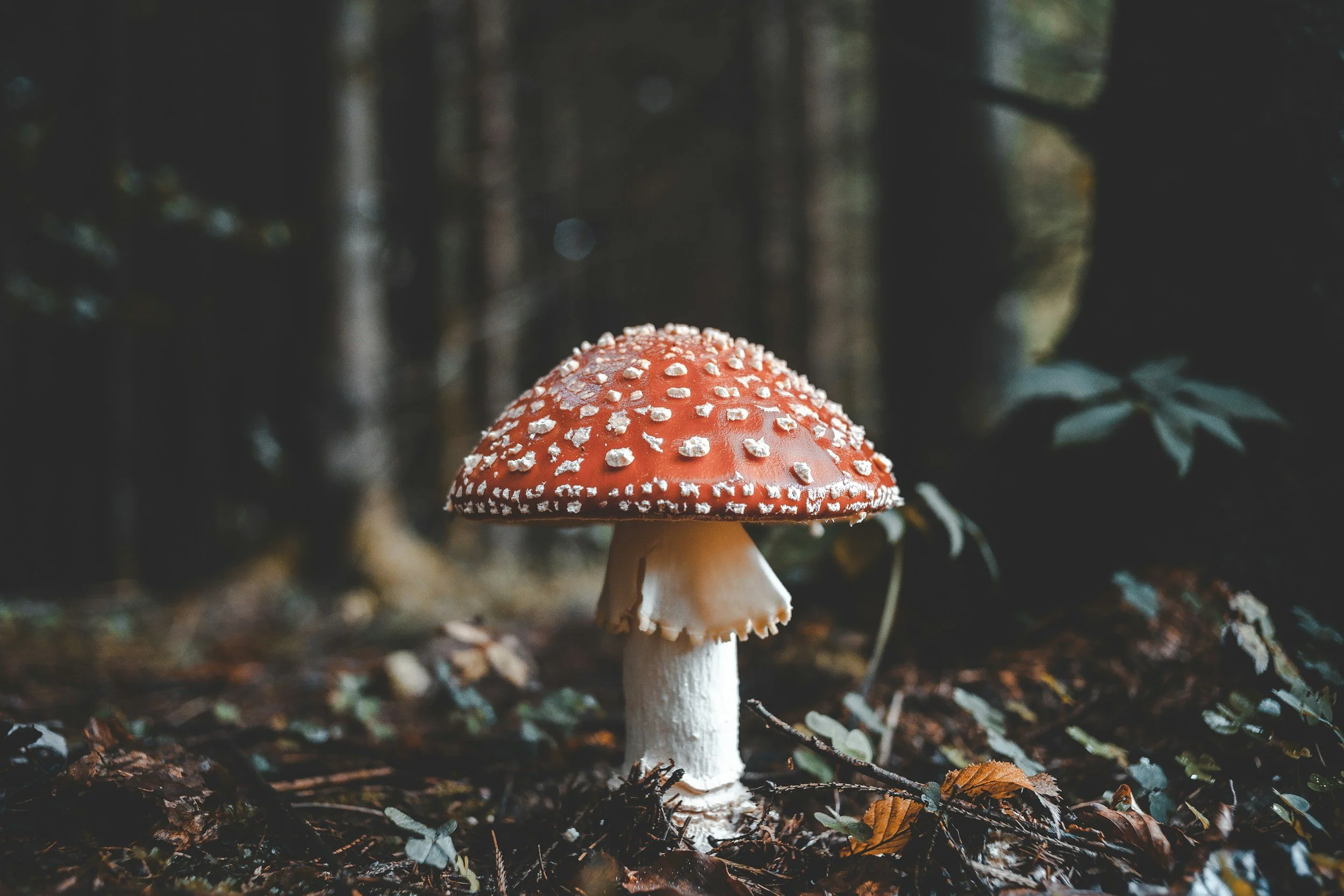
On Faeries, Part I
I had met with Gwynn ap Nudd, the “Faerie of the mound.” The encounter left me elated, almost euphoric. Are faeries real? The question hung over me; the implication being that perhaps other things were real too. Bigfoot? UFOs? Werewolves? God, I hoped not. A general rule for myself had always been to be sceptical of things I haven’t directly encountered or experienced. This ‘rule’ had served me well. It kept me level-headed in the face of the unknown, and more importantly, served as a safeguard against fantastical delusions and gullibility. I’ve never seen a Bigfoot or a werewolf, so I could safely put that possibility aside in the realm of imagination. UFOs? Well, I had seen something unexplained on a late-night commute, but that’s a story for another time…
If faeries are real, what are they? My first impression, upon meeting Gwynn, was that they are pre-human inhabitants of this Earth. Since humanity’s arrival, they have lived and prospered alongside us in a parallel reality. This parallel reality bleeds into ours, and ours into theirs. It is a symbiotic relationship, although one that has been suffering for an era. Of course, this is just one of many theories. Scholarly research provides four other main explanations for faeries: 1) The faeries are a “race-memory” of pygmy Brithonic people. 2) The faeries were once pagan gods and goddesses whose importance was reduced by the onslaught of Christianity. 2) The faeries are fallen angels (again influenced by Christianity). 4) The faeries are the souls of the dead. Held up to scrutiny, none of these theories firmly stand.
The faeries being a “race-memory” was most famously popularized by Margaret Murray. Murrey is best known for her book, “The God of the Witches,” which has since received scholarly backlash. Despite that, I do recommend reading it for its cultural (and not historical) context of the belief in witchcraft. She believed that the ancient Britons were driven into the hills by the invading Celts or Saxons and took to living in caves and hunting animals with poison darts. This would explain the faeries’ aversion to iron (anti-industrial), their small stature (result of a non-agricultural diet), the findings of arrowheads (described in lore as “elf-shot”), and their love of nature (being hunter-gatherers). The problem is that there is not a single piece of supporting evidence. The ancient Britons left no written records, nor is there any archaeological evidence. Furthermore, faeries of lore are not confined to being underground (though some are).
The faeries being gods of yore was once, and still is, a popular theory. The problem here is that some of the examples of so-called “pagan gods” are in themselves Christian inventions; eg. “The Green Man / The Green Knight” is a twelfth-century literary invention. The issue here lies in cultural relativity. To call the faeries ancient gods now, in the 21st century, is odd when that idea was already scrutinized by the 12th century. To quote Diana Purkiss, in her book, “At the Bottom of the Garden: A Dark History of Faeries, Hobgoblins, and Other Troublesome Things,”“To say that faeries were once gods is helpful in the sense that it is helpful to say that cars were once ox-carts; such a statement would be of limited value if hat we wanted was to understand why cars were so important to people.” I must push back slightly against Purkiss at this point, for it is true that some faeries were/are pagan gods. Gwynn ap Nudd is one such faery. Alas, more on him later.
The belief that faeries are fallen angels who rebelled against God goes back centuries. This theory has dwindled in recent years, but is still held particularly by some Irish Christians (if they believe in faeries at all). The thought is that because they are neither good enough for Heaven, nor bad enough for Hell, they are cursed to remain on Earth. This theory, being heavily influenced by the spread of Christianity, should not (in my opinion) be given much stock; faeries are pre-Christian, so giving them a Christianized explanation only perverts their origin story.
Lastly, the theory that faeries are the souls of the dead is steadfast. Alas, they are not any old spirits of the dead, but are specifically the unbaptized ones. Within Catholicism, unbaptized babies cannot enter heaven. I think it's harsh, but I’m an ex-Protestant. In Ireland, there are graveyards of unbaptized babies on known faerie grounds; the belief being that the faeries will look after the children in the afterlife. I quite adore this idea. Contradictively, there are stories of bishops or other figures within the church being abducted by faeries after their deaths. The explanation here is that, in life, they had insulted the faeries and must pay a penance in death. What I find more interesting is the idea that the souls of the dead can join the faeries, but are not necessarily faeries themselves. There are stories of people who have witnessed a faery procession and seen either a deceased loved one or someone still living. The living person who was seen then dies soon thereafter.
So, not only do the faeries accept the souls of the dead into their fold, they also portend the deaths of those they’d like to collect. This idea is very popular within cultures that have a belief in the Wild Hunt, or a variation thereof. The Wild Hunt is a storm-like spirit procession that collects the souls of the dead and dying. The Hunt is led by either a god, such as Wodan/Odin, or a goddess, such as Holda or Artemis, or a faery. In this blog, I am barely scratching the surface of this phenomenon. If you are interested in learning more, I would recommend the book, “Phantom Armies of the Night: The Wild Hunt and the Ghostly Processions of the Undead,” by Claude Lecouteux. One such faery who leads the Wild Hunt is, coincidentally, also Gwynn ap Nudd. What they all have in common is their connection to being warriors and hunters.
One theory that I did not mention in this post, but have in another, is the thought that faeries (and other phenomena) are part of a “daimonic reality.” They are not flesh and blood, nor are they entirely products of our imagination (the “psychological model” favored by occultists such as Aleister Crowley). They can cause physical impact on our reality, but are not wholly physical themselves. They are archetypal and individualized. They are paradoxical by nature. This is why beings such as Bigfoot, or extraterrestrials, have never been caught, captured, or killed.* They are not of this realm and therefore are not bound by its rules. Their reality oftentimes blinks or bleeds into ours. It is not like a wall or screen that separates them from each other, but more like a lake turnover that gradually flips to and fro between frequencies. Some believe that this merging will overlap to the point of complete immersion. I favor this theory. For one, it would help explain the uptick in paranormal sightings over the last few decades. Secondly, it would explain why these things tend to flicker in and out right before our very eyes. I cannot know if complete immersion of realities will occur, but I do wish for it! One such book that explains this in great detail is “Daimonic Reality: A Field Guide to the Otherworld,” by Patrick Harpur.
* If I had the chance, I would ask Harpur what he thinks of the recent UAP (Unidentified Aerial Phenomenon) Senate hearing in the USA. A link to that hearing can be found HERE.

Cave Initiation
In the previous post, “Kripalu Retreat,” I detailed a few trance experiences that helped shape my practice by introducing a significant figure, the man in the white robe. Jung would certainly describe him as the Sage archetype, which he certainly is. If he was ever at one point “real,” and by that I mean human, is unknown. More will be revealed about him as I write this blog. In this post, I detail my first encounter with another powerful entity by the name of Gwynn ap Nudd. Those of you who are well-versed in Welsh mythology or listen to Jo Hickey-Hall’s podcast, “The Modern Fairy Sightings Podcast,” will be familiar with him.
At the time of this experience, I was reading “By Oak, Ash, & Thorn: Modern Celtic Shamanism,” by D.J. Conway, and decided that I would give the “Cave Initiation” (page 76) a try from the comfort of my bedroom. Conway’s works (died Feb. 1, 2019) receive a lot of criticism for not being entirely historically accurate. Those critiques are valid, though I must agree that a resource does not always need to be historically precise for it to be meaningful. Heck, all of Wicca is built on a false notion of an unbroken witchcraft tradition, and thousands of people find that their magic works. Margaret Murray’s “research” and thesis, though untrue, still sparked the imagination and laid the groundwork for a modern-day witchcraft revival.
In this “Cave Initiation,” Conway gives a framework for a guided meditation that is meant to introduce the reader to an “elf, faerie, or one of the Celtic deities” who “asks why you wish to become a shaman.” You can already see the historical incongruities here (the word “shaman” would not have been known or used in Celtic societies). Nevertheless, what she is instructing is a valid approach to entering daimonic reality and meeting with a daimon. I know this not because of historical documents, but because it worked.
The cave is as archetypal an image as my white robed man, the Sage. Plato believed it represented ignorance, while Jung thought of it as the realm of the Unconscious. In Celtic traditions, caves were portals to the Otherworld or even the domain of supernatural beings. If you don’t have access to a cave, homemade is fine! Create a blanket and pillow fort or set up a tent. The important part here is to limit the amount of light that gets through. I suppose you could wear an eye mask, but where is the fun in that?
Lastly, you’ll want to either have a friend drum for you or listen to an audio recording. In this post, I won’t lay out the exact meditation. I am only describing to you what my experience was like. In the future, I will post on how to make contact with your Familiar (personal daimon) and will provide step-by-step instructions. Below is the detailed account.
“I opened my eyes, and to my right, I could see before me a low mountain range in the distance. In front of me was a vast plain, as far as I could see. There were short trees and small winding creeks. I walked onto the tall grass of the plain and heard the buzzing of insects and chirping of birds. I turned toward the left and walked down a hill. As I walked, the smell of moss and river water overtook my senses. The path led to a forested valley. I was naked, but did not appear like my physical self. I was older and covered in ornate spiraling tattoos. The markings covered my bald head, trailed down my neck, and covered the entirety of my back. I came upon a great mound with an entrance made of three stones. There were two slabs on the side and one across the top. On the top slab was a symbol carved into it. It was covered in dirt and moss. I removed the moss and saw three dots in a triangular formation. Lines appeared to connect them into the shape of a spiral with a circle in the center (pictured below). I entered the mound. It was dark except for a pale outline of what I thought was a blanket. I got closer and saw that it was the hide of a white bull. The hide was damp but warm. Freshly skinned? What happened next can only be described as being within a dream within a dream; I was pulled deeper into trance and awoke facing a tall, pale humanoid being. He was very fair-skinned, thin, with long dark hair, pale blue eyes, and elongated ears. I noticed that his ears were shredded in parts, like how a street cat’s ear might look. His eyes were further apart than a human’s, and his brow and nose bridge were wider, too. I asked him what he was. He responded, “The faery of the mound.” It was then that I noticed a much smaller figure poke out from behind him. This being, or creature, was genderless from what I could tell and was much uglier than the tall one. It had straggly grey hair, wandering lazy eyes, a slight hunch in its back, and skin covered in dirt. The tall one placed a large snake skin on my chest. The small one took it and wrapped it around my feet, legs, belly, chest, and up to my neck. I did not feel afraid despite being very much fearful of snakes in “real life.” The tall one then dumped many small snakes on top of me. What I saw next was like watching a time-lapse video of the lifecycle of a snake; they grew, molted, died, decomposed, and started all over again. Crow was with me the entire time. He grabbed a few of the small snakes and ate them, perhaps wanting to be a part of the action? The small being shook his head and left for a moment. It soon returned to me with a bowl of liquid. The tall one lifted my head while the small one put the bowl to my mouth. The liquid moved like smoke and was warm. I felt soothed. When I finished drinking, the tall one placed his index and middle finger to my forehead, between my eyes. I saw a vision of my older self. I was cloaked in a black feathered hooded cape. I wore a bird mask and held a staff. I was standing at an unknown forest’s edge. A murmuring dark mass flew all around me. It felt menacing, but I was not afraid. I reached into the darkness and grabbed at a screaming face. The face attempted to bite at my hand, but I held firm, and it could not escape. The longer I held on, the louder its screams became. Using my staff, I knocked the tip of it against the face, and it turned to ash. I then sat upright and was given some time to speak to the two beings. I asked if I would be seeing more of them. They nodded. I then asked for its name. The taller one responded. “Gwynn.”